Each year, increasing volumes of global capital flow toward mission-driven, public outcomes. However, fragmented terminology, such as “non-profit”, “development organisation”, or “impact investor”, continues to obscure the domains’ coherence and global impact.
Without shared language, the domain operates without shared infrastructure, without coordination incentives, and without consistent institutional recognition. Subsequently, performance is constrained: promising practices diffuse slowly, evidence remains localised, and collective effectiveness is weaker.
This domain is not a residual category. A recent United Kingdom (UK) study estimated that up to 15% of Gross Domestic Product (GDP) is directed toward impact, alongside or above profit.
This essay argues that the For Purpose domain functions as a distinct mode of economic activity but is constrained by underinvestment in meso-level infrastructure.
What is the For Purpose domain?
Modern economies are typically framed through two coordinating systems: markets and states. Yet a mission-driven, for-purpose system has been operating and growing alongside them, obscured in reporting by their legal and tax status.
What unifies these actors is mission primacy: delivering goods and services that generate high spillovers beyond the value captured, generally requiring hybrid financing. For example, a charitable trust providing low-cost rent to social enterprises while reinvesting surpluses into community programs, or a fair-trade cooperative improving farmer incomes while funding local services, both exhibit mission primacy, hybrid financing, and diffuse value capture. Because organisations in this domain deliver essential services, influence behaviour at scale, and absorb risk where markets and public systems are constrained, they constitute a distinct mode of value creation rather than a residual category (Mazzucato, 2013).
An example: Donkey Wheel House, Melbourne
Donkey Wheel House demonstrates how the three operational conditions appear within a single, multi-entity structure. Established in 2004, the organisation functions as a “living commons for changemakers,” offering space and support to a current group of 12 tenants. Public value is generated and shared through networks, cultural production, and social innovation.
Read more
Inclusion in the For Purpose domain can be defined by operational criteria rather than by intent or branding. These include:
- formal mechanisms that lock in mission over or alongside profit maximisation, e.g. a Steward-Ownership model,
- demonstrable diffusion of value beyond owners or investors (positive spillovers), and
- reliance on hybrid financing, i.e. a capital structure that strategically blends non-market and market-based funding sources (Salamon, 2012).
These criteria preserve diversity while establishing conceptual boundaries. For analytical completeness, direct private-sector investment in mission-driven outcomes is included when measurable spillover value is generated.
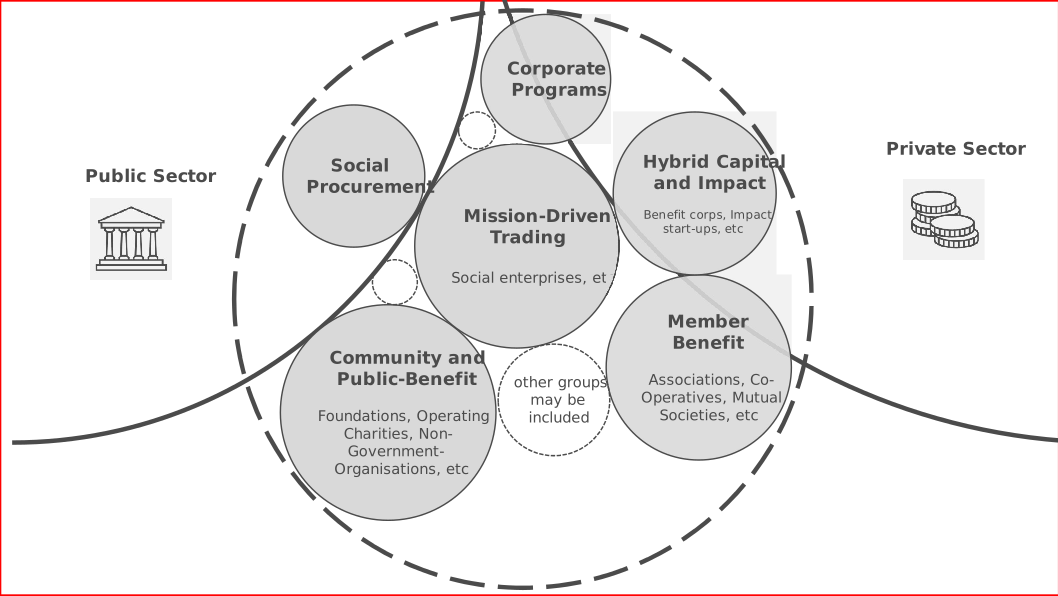
The diagram below illustrates the potential boundaries of the domain.
Additionally, while many actors in this domain are self-regulating and independent of government, many actors derive a significant proportion of their revenue from government sources. Over the past decade, Australian charities and not-for-profits generated, on average, 45-50% of their revenue from government sources. This structural dependence on public financing to sustain activities also presents an opportunity for public policy to shape the domain.
The idling, multi-trillion-dollar engine
Accurately estimating the global scale of the For Purpose domain is challenging. A lack of shared terminology, data, and reporting across jurisdictions hinders the creation of meaningful, comparable statistics and narratives. Nevertheless, available data suggest the scale of the domain could be in the range of 5 to 15%+ of global GDP.
- Globally, social enterprises alone support an estimated 200 million jobs and contribute approximately 1 to 2% of GDP through direct activity.
- In Australia, social enterprises together with charities and not-for-profits contribute approximately 6% of GDP and employ around 12% of the workforce.
- In the United Kingdom, a 2026 report estimated that the impact economy contributes 15% to GDP. The impact economy is the broadest definition identified, noting the definition excludes other forms of organisation, such as co-operatives and employee-owned businesses, which may fall within the domain on a case-by-case basis.
If the For Purpose domain operates at a material scale and is not treated as a coherent economic system, why do we keep letting this multi-trillion-dollar engine idle?
The chronic value creation and capture mismatch
The For Purpose domain exhibits classic public goods dynamics. Capital generates high public value, including improved well-being, social cohesion, and environmental resilience, but only a fraction of the value is captured in revenues or investable surpluses (Samuelson, 1954; Ostrom, 1990). This creates a structural reliance on hybrid financing and governance arrangements that protect the mission while constraining margins and strategic flexibility to invest in growth and development (Ebrahim et al., 2014; Salamon, 2012). This is often by design, particularly in social enterprise models.
These spillovers also translate into measurable fiscal effects, including reduced downstream expenditure in health, justice, and social services. However, these fiscal benefits are also not captured by originating organisations and remain external to funding models, thereby reinforcing underinvestment in high-impact activities.
Another example: Australia's Mental Health System
Australia’s Productivity Commission estimates the cost of mental ill-health and suicide at approximately $200 to $220 billion per year, or around 10% of GDP, including $40 to $70 billion in direct economic costs. Evidence indicates that early intervention improves participation and reduces long-term demand on health, justice, and welfare systems, and has been estimated to yield a return on investment of $1 to $10.50 for each dollar spent. The For Purpose domain is a major provider of community-based mental health services, yet investment remains concentrated in downstream acute responses. Redirecting investment toward coordinated prevention shifts fiscal trajectories across systems, not just individual outcomes.
Read more
As a result, capabilities with the highest system value and low private returns, including shared data, evidence synthesis, standards, coordination, and collective advocacy, are systematically underprovided (OECD, 2019).
This cycle continues to reinforce the mismatch between value creation and value capture, demonstrating a structural rather than an incidental constraint.
Fragmentation as a systemic outcome
With limited incentives for coordination, fragmentation emerges as a rational system response rather than a managerial failure. Benefits from coordination accrue broadly to governments through reduced expenditure, to markets through stability, and to communities through improved outcomes, while individual organisations bear costs. Free-riding is therefore structurally embedded (Arrow, 1962; Olson, 1965; Stiglitz, 1989).
National peak bodies partially mitigate these dynamics, but their mandates remain narrow, and their funding is constrained. At the global level, coordination challenges intensify where problems are transnational, but authority, legislation, and policy remain national (Rodrik, 2011).
Fragmentation also reflects political economy dynamics. Dispersed providers can be easier for governments to manage, for funders to control through bespoke reporting, and for intermediaries to shape through proprietary standards and data. Infrastructure development is therefore not neutral: it redistributes power.
In contrast, mature sectors do not rely on spontaneous coordination. They invest in meso-level institutions, standards bodies, research councils, and professional associations, thereby reducing transaction costs and aligning incentives (North, 1990). The For Purpose domain lacks this infrastructure layer, particularly across borders. The constraint is not delivery capacity, but the absence of an orchestrating function that connects actors, aggregates and translates evidence, and strengthens collective legitimacy without centralising control (Kania et al., 2018).
How to break the cycle
The causal chain is structural. High spillovers combined with low private returns lead to underinvestment in shared infrastructure. This produces fragmentation, duplication, and localised learning. In the absence of recognised infrastructure, policymakers and capital allocators continue to treat the domain as marginal rather than structural, reinforcing the underinvestment.
As noted earlier, language compounds this constraint. Without a shared descriptor, the domain struggles to appear on policy agendas as a coordinated system. A functional label such as “For Purpose” signals an economic organisation oriented toward outcomes rather than ownership form. However, clearer naming is necessary but insufficient on its own.
Firstly, policy design can enable system reconfiguration. When governments and major funders treat the For Purpose domain as a system, they can co-finance public-good capabilities with high social returns: interoperable data standards, shared evaluation protocols, and cross-border coordination. These capabilities improve policy effectiveness and funding efficiency and therefore function as infrastructure rather than program expenditure (OECD, 2019).
The first steps: UK Office for the Impact Economy
The Office for the Impact Economy demonstrates how governments can support coordination in the For Purpose domain. Established by the UK Government in November 2025, it acts as a central function to align capital, policy, and market infrastructure for impact. By convening stakeholders across finance, philanthropy, and enterprise, it reduces fragmentation and supports standard-setting, data development, and capital mobilisation. This approach enables government to catalyse system-level coordination without direct delivery, strengthening market formation and improving the allocation of capital toward measurable social and environmental outcomes.
Read more
Secondly, the domain is structurally diverse, encompassing multiple legal forms, financing models, and practice traditions. No single actor holds sufficient authority or information to define its infrastructure. A structured discovery process, combining literature synthesis, comparative case analysis, and cross-sector engagement, can identify patterns, map existing coordination functions, and test alternative system configurations (OECD, 2016; UNDP, 2022).
For now, the work continues
The For Purpose domain already operates as a distinct mode of economic organisation; however, its defining characteristics, high spillovers and low private returns, systematically constrain investment in the institutions required for coordination.
Recognising the For Purpose domain as a coherent economic system is a necessary precondition for investment. Where blended finance and dedicated endowments can stabilise meso-level institutions, provided governance safeguards prevent value capture and maintain mission integrity.
Therefore, continuing to quantify macro-level contributions supports not only policy prioritisation across employment, fiscal effects, risk reduction, and well-being, but supports investment attraction. However, these metrics should complement, not displace, qualitative and relational forms of value that resist monetisation, such as Social Return on Investment.
Ultimately, sustainable system performance depends on preserving diversity while building coordination infrastructure. Diversity enables experimentation, innovation, and resilience, while infrastructure enables alignment and diffusion. Without both, fragmentation persists, and opportunity costs remain high.
References
Arrow, K. J. (1962). Economic welfare and the allocation of resources for invention. Princeton University Press.
Ebrahim, A., Battilana, J., & Mair, J. (2014). The governance of social enterprises. Strategic Management Journal.
Kania, J., Kramer, M., & Senge, P. (2018). The water of systems change. FSG.
Mazzucato, M. (2013). The entrepreneurial state. Anthem Press.
North, D. C. (1990). Institutions, institutional change and economic performance. Cambridge University Press.
OECD. (2016). Social innovation policy framework.
OECD. (2019). Social impact measurement for the social economy.
Olson, M. (1965). The logic of collective action. Harvard University Press.
Ostrom, E. (1990). Governing the commons. Cambridge University Press.
Rodrik, D. (2011). The globalization paradox. Oxford University Press.
Salamon, L. (2012). The state of nonprofit America. Brookings Institution.
Samuelson, P. A. (1954). The pure theory of public expenditure. Review of Economics and Statistics.
Sen, A. (1999). Development as freedom. Oxford University Press.
Stiglitz, J. (1989). Markets, market failures, and development. American Economic Review.
UNDP. (2022). Social innovation for development.